Thursday

Nigeria's Shoreline Agrees $530 Million Deal to Boost Oil Output

Shoreline Group, a Nigerian oil producer, plans to almost double its crude output after agreeing a $530 million finance deal with an international oil trader and local lenders.
Image result for KOLA KARIM
Shoreline will seek to boost production to between 80,000 and 100,000 barrels a day this year, Chief Executive Officer Kola Karim said. The company currently pumps about 55,000 barrels a day. The funds are being provided by an international oil trader, a specialist fund and four local lenders, said Karim, who declined to name them until the deal is signed later on Thursday.
“The deal entails refinancing Shoreline and providing us working capital to expand production,” he said Thursday in a phone interview from Lagos, Nigeria’s commercial hub.
Shoreline is one of several Nigerian producers that bought fields in the oil-rich Niger River delta after international producers including Royal Dutch Shell Plc withdrew amid persistent attacks on infrastructure. The company didn’t pump oil for a year following an attack on the Forcados terminal in February 2016. Flows resumed after the link was reopened in June last year.

EU investing heavily in security and human development in Nigeria.

The European Union supports Nigeria's efforts to fight terrorism and improve security in northern Nigeria, where conflict with Boko Harram has claimed tens of thousands of lives. European Commissioner Karmenu Vella today presented the work of the EU in Nigeria to the Members of the European Parliament (MEPs) as part of an "urgency" debate on human rights, democracy and rule of law in the country.
Image result for EU


Yesterday suicide bombers killed at least twelve people in the North-East of Nigeria. On the same day, a Canadian and an America citizen were kidnapped in Nigeria, and two policemen got killed in the exchange of gunfire with the kidnappers. "It is a sad reminder of how volatile the security situation in the country still is, and how crucial it is to address this situation to unleash Nigeria's immense potential," Commissioner Vella said on 18 January in a discussion with MEPs. The EU supports both politically and financially the Multinational Joint Task Force which brings together Niger, Chad and Cameroon in a counter offensive against Boko Harram and has already mobilised over EUR 155 million to address the humanitarian crisis and an additional EUR 50 million for development in North Eastern Nigeria, which is Africa’s most populous country and its largest economy, noted the Commissioner.
"We, as the European Union, are investing strongly to help the people of Nigeria to bring their country forward. We invest in innovation, for instance with the Digital4Development initiative, in energy efficiency, in local entrepreneurship, in the green economy and the fight against climate change. The European Investment Bank is about to increase its portfolio in the country," added Vella.
In seven years of conflict in north-eastern Nigeria, over 20 000 people have been killed and 1.82 million displaced. The humanitarian situation remains dramatic and the high level of insecurity across the area continues to seriously hamper access and the delivery of assistance.
In 2014, around 270 schoolgirls were abducted from a school in Chibok, north-east Nigeria by Boko Haram. Most were probably forced to either marry insurgents or to become insurgents themselves, subjected to sexual violence or sold into slavery, and non-Muslim girls were forced to convert to Islam.
Over 80 girls kidnapped by Boko Harm were finally released in May 2017. Upon their release, High Representative Federica Mogherini, said that ‘the EU continues to stand shoulder to shoulder with Nigeria in its fight against terrorism and in its tireless work to free the girls. The EU also continues to be fully committed to supporting humanitarian, development and reconstruction work in Nigeria.’ 
The EU provides immediate assistance to cover the basic needs of those internally displaced, host populations in Nigeria as well as refugees in other countries affected by the Lake Chad basin crisis, namely Chad, Niger and Cameroon.
Funds go to food distributions, to clinics providing lifesaving nutrition medical care, as well as to ensure access to water and sanitation, hygiene, first-need items, shelter and protection. They also contribute to increased access, through the Humanitarian Air Service, and to the coordination of humanitarian organisations.
In addition to the conflict in the North-East, there are other violent conflicts in Nigeria, including in the South-East (Biafra) and the oil-rich Niger Delta. Clashes between farmers and herdsmen in the so-called Middle belt have caused hundreds of deaths. While the herders are mainly Muslim and the farmers mainly Christian, the conflict reflects as much the limited access to land fuelled by climate change and demographic growth. There is however concern that the conflicts can turn more religious with time, with dire potential consequences.
The upcoming elections in February 2019 will likely add to the complexity. The EU regularly sends Election Observation Missions to Nigeria.
The Commissioner noted that EU High Representative Federica Mogherini hopes to visit Nigeria again in the near future for the next Ministerial dialogue, to raise the EU's concerns and to push cooperation forward. 

Nigeria Intervention Movement (NIM),vowed to rescue Nigeria in 2019.

Nigeria Intervention Movement (NIM), which has former Cross River State governor, Donald Duke, former governor of the Central Bank of Nigeria (CBN), Charles Soludo, Senior Advocate of Nigeria, Olisa Agbakoba, Tafawa Balewa, and Prof. Pat Utomi, as members, has vowed to rescue Nigeria in 2019.
Image result for intervention

The group said it would be providing an alternative to the All Progressives Congress, APC, and the Peoples Democratic Party, PDP.
Former Education minister, Mrs. Oby Ezekwesili is also a member of the group, including former Information minister, Frank Nweke Jnr, Col. Abubakar Umar (retd), Ayo Obe, Rabiu Ishyaku Rabiu, former presidential adviser, Akin Osuntokun.
A statement from the NIM secretariat in Abuja, yesterday, described the group as a pro-democracy movement and pressure group of like-minded Nigerians who are committed to changing the political order, which has failed to fashion a Nigeria that works for all.
“NIM is concerned that the political elite, since independence, and particularly, since the exit of the military from visible power in 1999, has proved that it is ill-equipped and unprepared for the challenge of transforming our nation from its under-developed status to one that is prosperous and can create a veritable environment for the realisation of its citizens’ potentials and well-being.
“It is clear that the political elite, as currently represented by the two dominant political parties, the Peoples Democratic Party (PDP) and the All Progressive Congress (APC), among others, have failed Nigerians, for lack of clear Ideology and principle on how to run the country.
“Concerned that left to their schemes and antics, this class of entrenched leaders will lead Nigeria into a state of indescribable human misery, characterised by death, hunger, disease, illiteracy and manipulation.
“Therefore, the NIM, being unable to continue to stand aloof, has decided to create a third political force, a platform to mobilise all citizens of goodwill and conscience towards engendering a new political system and culture in Nigeria, capable of bringing about the desired opportunities for all to actualise their dreams and potentialities; a nation where no man or group is oppressed.”
The statement noted that to drive NIM’s vision are: Dr. Olisa Agbakoba (Co-Chair); Dr. Jhalil Tafawa Balewa (Co-Chair); Professor Pat Utomi (Deputy Chair); Rabiu Ishyaku Rabiu (Deputy Chair); Comrade Isah Aremu (Deputy Chair) and Chief Akin Osuntokun (Deputy Chair).
Other officers include Hajia Aisha Aliyu (Women Leader), Mr Dayo Israel (Youth Leader), Dr Osagie Obayuwana (Legal Adviser), Hajia Shetu Alfa Ibrahim (Treasurer), Mallam Naseer Kura (Publicity Secretary), Col. Abubakar Umar Dangiwa (Ex -Officio), Dr Oby Ezekwesili (Ex -Officio) and Mrs Ayo Obe (Ex-Officio), Sir Olawale Okunniyi (National Secretary/Director General).
Chairmen of standing committees are: Mr Donald Duke (Finance Committee); Prof Jibrin Ibrahim (Ideology Commission); Comrade Najeem Usman (Political Commission); Mallam Tanko Yinusa (Mobilisation); Mr Wale Ajani (Students & Youth); Mr Taiwo Akinola (Diaspora Commission); Mr Tony Uranta (Strategy & Engagement) and Mallam Shittu Kabir (Contact/Logistics).

BUHARI 2019 WILL BOOST NIGERIA ECONOMY PLUS WEST AFRICA.


Image result for BUHARI

President Mohammed Buhari of Nigeria one more chance

With strong improvement in investor sentiment emerging IF Buhari is back in 2019.

Buhari 2019 will Boost Nigeria Economy plus West Africa if Buhari is back.


Wednesday

Stakeholders bemoan 2017 challenges, hope for better 2018

At the outset of 2017, the Federal Government had raised a lot of expectations regarding the future of Nigeria’s petroleum sector, upon which the entire economy revolves.        
Image result for NIGERIA OIL

  
But as the year ended, things did not turn out quite the way they were envisioned. Indeed Nigerians celebrated the year end with acute fuel shortages, even as many of the targets set for the industry were not realised.Analysts attribute the development to disconnect in set objectives between the Ministry and its supervisory units especially the Nigerian National Petroleum Corporation (NNPC), and other parastals and agencies under it.
  
Although the country recorded some progress in helping to foster peace and reduce militancy in the oil producing areas as well as the implementation of a new funding model for Joint Venture operations, however, stakeholders still await the execution of the many promises made during the last financial year.
Nation’s refineries remain idle One of such promises that elicited high hopes among Nigerians was the Federal Government’s plan to make the four refineries in Port Harcourt, Warri, and Kaduna fully functional within three months to guarantee uninterrupted fuel supply in the country.Besides, the Minister of State for Petroleum Resources, Dr. Ibe Kachikwu, spoke about building strategic reserves for petroleum products to guarantee the self-sufficiency and boost export drives, which have not seen the light of day.
  
Unfortunately, the refineries are still operating below capacity. Besides, rather than ramping up, capacity utilisation in the refineries continues to slip. For the month of May 2017, the three refineries recorded a combined capacity utilisation of 23.09 per cent compared to 24.59 per cent achieved in April.
Acute fuel scarcity
Although, there was free flow of Premium Motor Spirit (PMS) also called petrol, from January to October, the pains witnessed by consumers of petrol within the last two months of 2017 is something, stakeholders want the Federal Government to find permanent solution to in 2018.Also, most other white products including household kerosene (HHK), and aviation turbine kerosene (ATK) or Jet A1, remained scarce for the greater part of the year. Neither the Ministry nor the NNPC could effectively explain the cause(s) of the scarcity, with attendant blame games.However, industry sources attributed the scarcity to the failure of crude swap programme, as companies contracted for the deal in exchange for refined petroleum products could not deliver as scheduled.
Besides, many of the firms engaged for the programme were merely contracted for political patronage rather than expertise or capacity to deliver, a development critics insist must be eschewed to avert continued scarcity in the current year.  
 
The Director General, Lagos Chambers of Commerce and Industry (LCCI), Muda Yusuf, frowned at the monopolistic right given to the NNPC to import fuel, saying the model is fraught with inefficiency, transparency issues,  perpetuation of culture of patronage, and imposes a huge burden on the treasury of government.He said a fundamental policy review is imperative and urgently needed to correct the anomaly.
Crude oil production still below 2 million barrels per day
During the year, Kachikwu had promised to ensure that Nigeria’s crude oil production capacity would hit three million barrels per day (mbpd) by the end of 2017, but output fluctuated between 1.5mbpd and 1.7mbpd, according to latest data from the Organisation of the Petroleum Exporting Countries (OPEC).
 
Furthermore, the expected investments needed to boost crude oil production were not coming due to the prolonged approval cycle, often criticised as a disincentive.A contracting cycle is the duration from the initiation of a bidding process through registration of contractors, and actual award of contracts for projects to be executed in the petroleum industry.
 
But Kachikwu had also promised to slash the contracting cycle from the current average of between two and four years, to just six months, he blamed the long contracting cycle on the high cost per barrel of oil produced by Nigeria, compared to other OPEC member countries.
  
Decrying the long tendering process in Nigeria, the Chairman/Chief Executive Officer, Oilserv Limited, Emeka Okwuosa, called for an end to such practice, saying: “When you start a tender and the tendering process goes beyond six months, you are in a different territory.“You have a situation where inflation may have changed, prices may have changed. Some tendering processes take up to 18 months. That should end. It requires concerted efforts. There should be a way to streamline the process of tendering to make sure that it is within a shorter time.”
Tackling inherent challenges
The Managing Director, Oil and Gas Soft Skills Limited, Emmanuel Emielu, said the Federal Government has done well in creating a framework to offset the cashcall arrears with the International Oil Companies (IOCs).But he noted that the government is yet to resolve the Niger Delta crisis, adding that the newly launched oil and gas policy document need to be fully implemented. “Government should be able to translate the policy into actual actions. The policy is only offering an element of hope in the industry, but when the hope is differed, there will be problems.”
 
Emielu stressed the need to fight corruption in the country’s oil sector. “Corruption is the reason why Nigeria’s contractual circle is long. The efficiency on the contracting process can also lead to high cost of executing a project and high cost of production in the oil and gas sector.“When there are inefficiencies in the system, investors will begin to move their investments to other countries, like Ghana, Angola, and South Africa,” he added.
 
The Chairman, Society of Petroleum Engineers (SPE), Saka Matemilola, said the history of poor commercial performance in the domestic gas sector makes gas production unattractive and discourages investments.
 According to him, the regulation of gas prices particularly gas supplied to the domestic power sector under the Gas Pricing Policy is perceived as a disincentive to investment in the upstream sub-sector.
 
On the feasibility of Nigeria becoming self-sufficient in petroleum refining, the Chairman, LCCI Petroleum Downstream Group, Ken Abazie, said there is nothing on ground to show that Nigeria will become self-sufficient by 2019.According to Abazie, the possibility of Dangote Refinery meeting the 2019 target is not certain. “The Minister is relying on the completion of the Dangote Refinery, which he believes will contribute to Nigeria attaining self-sufficiency in petroleum refining. But the company is not close to producing petroleum products; it is still building storage facilities. Unless there are other refining capacities, which we don’t know about, it is not just possible to become self-sufficient by 2019,” he added.
 
For the Pioneer Director, Centre for Gas, Refining & Petrochemicals, Institute of Petroleum Studies, University of Port Harcourt, Godwin J. Igwe, achieving success with Kachikwu’s proclamations is more about walking the talk.He said: “I will suggest we encourage self-reliance and diversification to maximise our production of petroleum products through modular refineries. We need more doers, not talkers; more hands-on professionals; more manufacturers to support consumers. I believe we have been able to ignite interest by creating innovative ways to bring awareness through modular refineries to end fuel scarcity in Nigeria.” 

Nigeria. Rice Importation To Stop In 2018- Buhari

President Muhammadu Buhari says Nigerians have got to get used to discipline and direction in economic management as the days of business as usual are numbered.

The president stated this in his address to the nation in Abuja on Monday to mark the beginning of 2018.

According to him, it is in view of this reality that in 2015 he appealed to people to go back to the land.

He announced that Nigeria would stop importation of rice from 2018, to encourage the production of local rice.
Image result for IMPORTATION OF RICE TO NIGERIAN

“I am highly gratified that agriculture has picked up, contributing to the government’s effort to re-structure the economy.

“Rice imports will stop this year. Local rice, fresher and more nutritious rice will be on our dishes from now on.

“By the same token, I am today appealing to enterprising Nigerians with ideas and unemployed graduates and other able-bodied and literate men and women with ideas, not to just sit and wait for employment from the government or the Organized Private Sector.

“Great nations are built by enterprising people who turn their hands to anything that circumstances dictate,’’ he said.

He noted that the All Progressives Congress-led Federal Government was slowly stabilising the economy.

The president further said that the diversification efforts embarked upon by the government had resulted in improved output, particularly in agriculture and solid minerals sectors.

He also maintained that the relative exchange rate stability had improved manufacturing sector performance.

On power, President Buhari noted that more Nigerians across the country were experiencing improved power supply to their homes and businesses.

He, however, observed that power had remained a concern to his administration because not many people enjoyed regular and reliable supply.

He stated that the Payment Assurance Guarantee Scheme, which started in January 2016, had enabled the Nigerian Bulk Electricity Trader to raise N701 billion to assure Generation Companies of at least 80 per cent payment for any power delivered to the national grid.

Consequently, he said generation had now reached 7,000 megawatts while on December 8, 2017, the country achieved 5,155 megawatts of power delivered to consumers, the highest level ever recorded.

Image result for IMPORTATION OF RICE TO NIGERIAN

According to the president, several moribund projects have been revived while repairs of Afam Power Station added 110MW in 2017 and another 240MW will be added this year through a private investment partnership.

“Katsina Power Project is now being tested and producing 10MW of power from wind for the first time in Nigeria. It should be fully operational this year.

“The Zungeru 700MW Hydroelectric Power Project, stalled by court cases is due for completion in 2019.

“The transmission and other requirements to operate the 30MW Gurara Phase 1 Hydroelectric Plant, the 40MW Kashimbilla Hydroelectric Plant and the 215 MW Kaduna Gas/LPG/Diesel Power Plant will also be completed this year.

“A landmark project, Mambilla Hydroelectric Power Project, is at last taking off. This project has been on the drawing Board for 40 years,’’ he said.

The president, however, revealed that the engineering, procurement and construction contract for the Mambilla 3,050 megawatts project had been agreed with a Chinese joint venture company with a financing commitment from the government of China.

He said 2023 was targeted as completion period for the project.

President Buhari also noted with delight that the Transmission Companies of Nigeria (TCN) and the Niger Delta Holding Company had added 1,950 MVA of 330 down to 132 KV transformer capacity of 10 transmission stations and 2,930 MVA of 132 down to 33 KV transformer capacity of 42 sub-stations.

He said the sub-stations included those at Ikot Ekpene, Aba, Alagbon, Ajah, Ejigbo, Funtua and Zaria.

Nigerian New National Minimum Wage: Expectations and challenges

The inauguration of a 30-member tripartite National Minimum Wage Committee for the negotiation of a new National Minimum Wage for Nigerian workers has elicited a lot of expectations and hope among Nigerians.
Image result for nigeria new minimum wages


On November 27, 2017, President Muhammadu Buhari inaugurated the committee Abuja which governors and senior government officials, among other stakeholders witnessed. Although the committee has yet to begin sitting after inauguration, workers are keeping the hope alive in 2018 that the committee will come out with useful decisions when it completes its assignment.Image result for nigeria new minimum wages


Mr Solomon Michael, a civil servant, said: “I wish the Federal Government will conclude negotiation on the implementation of a new minimum wage so that I will know that my salary will rise to be able to cater for my kids. “But if a time frame had been given to the 30-member committee, it will help to hasten their efforts in reaching conclusion on the wage’’. Similarly, Mr Biobelemoye Joshua, President, Medical and Health Workers Union, said the organised labour would not allow government to use the minimum wage issue to score political point. “We are certain that if the government employs delay tactics for any reason labour will react,’’ he said. However, the optimism of some of the workers is rooted in Buhari’s statement during inauguration that the re-negotiation of a new national minimum wage had become imperative as the current wage instrument had expired. 

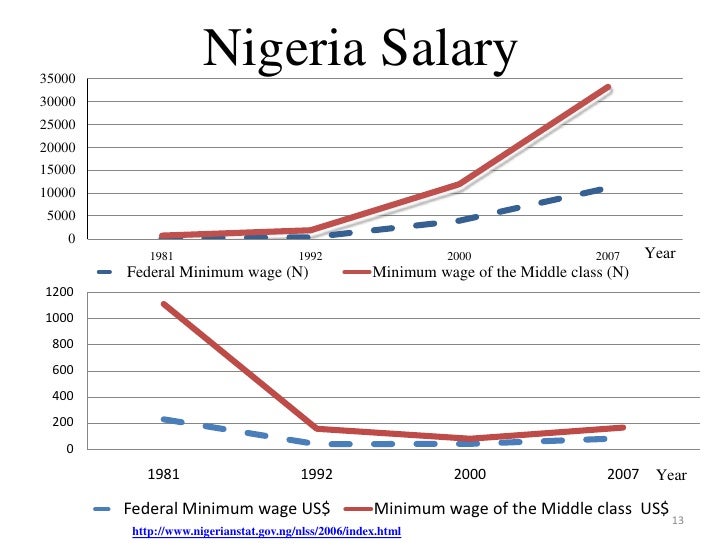
They also made reference to one of the president’s comment that “minimum wage must be consensual and generally acceptable and should be anchored on social justice and equity.’’ They recall that Nigeria joined the league of International Labour Organisation member countries that set minimum wage for their workers in 1981, observing that the country has not been reviewing the wage as it ought to do. 

During the inauguration, the president explained that the committee was formed following the recommendation of a technical committee put in place after the increase in the price of petrol in 2016. Analysts, nonetheless, observe that as workers call on the Federal Government to discuss a way forward on the present N18, 000 minimum wage, efforts should also be made to ensure the possibility of paying any increase on minimum wage to private sector workers. Expressing concern about this observation, Mr Goke Olatunji, President, National Union of Chemical Footwear, Rubber, Leather and Non-Metallic Products Employees, called on Federal Government to direct the state and private sector to implement the agreement on minimum wage. 

The Nigeria Labour Congress and Trade Union Congress have, as well, called on the committee to conclude everything concerning the new wage on or before the end of the third quarter of 2018. It says the committee should expeditiously conclude its assignment since review of the wage has been due for over two years to enable the National Assembly give it an accelerated passage. The labour had earlier submitted a proposal of N56,000 and N90,000 to the Federal Government as new minimum wage. Supporting the proposal, Mr Bobboi Kaigama, President, Trade Union Congress of Nigeria, noted that Nigeria’s N18,000 might be the lowest in Africa. 

According to him, Nigerian workers cannot afford to wait endlessly for the implementation of the new minimum wage in view of the economic realities as their monthly take-home pay can no longer support their demands. In the same vein, Ayuba Wabba, the NLC president said “it is our expectation that all issues pertaining the new minimum wage will be concluded before the end of third quarter of 2018 to give Nigerian workers a new hope that government and other employers of labour have not totally abandoned them. 

However, President Muhammadu Buhari did not give a time frame to the members during inauguration but expressed the hope that the outcome of the deliberation would be consensual and generally acceptable. “I urge you to amicably consider the issue of a National Minimum Wage and all matters that are ancillary to it with thoroughness and concern not only for the welfare of workforce but effect on the country’s economy. “We should aim to go above the basic Social Protection Floor for all Nigerian workers based on the ability of each tier of government to pay. “I say this because minimum wage is the minimum amount of compensation an employee must receive for putting in his or her labour and as such should be anchored on social justice and equity. “Government’s decision after considering your final recommendation will be sent as an executive bill to the National Assembly for it to undergo appropriate legislative scrutiny before passage into law. “I am hopeful that the principles of full consultation with social partners and their direct participation would be utilised by the committee, bearing in mind the core provisions of the International Labour Organisation Minimum Wage Fixing Convention No. 131 and Minimum Wage Fixing Machinery Convention No. 26 (ratified by Nigeria).

 “The committee is expected to complete its deliberations and submit its report and recommendations as soon as possible to enable other requisite machinery to be set in motion for implementation of a new National Minimum Wage. With the assurance of its implementation by the president after the committee’s recommendations, observers appeal to state governments to choose to use the federal wage or make their own laws. Corroborating this observation, Mr Salihu Lukman, an analyst, says issues of minimum wage are popular largely because, in some ways, the benefits are far beyond the target beneficiaries. “This is because of the consequential effect of wage adjustments for other categories of workers and citizens as a result of increasing the minimum wage,’’ he explained. A News Analysis by Chinyere Elele-Bassey, News Agency of Nigeria (NAN)

2019ELECTION: “SEVEN NORTHERNERS TO WATCH AHEAD OF 2019 ELECTION”

POLITICS – Here is current information reaching us as Doyin Okupe, a former aide to the immediate past President Goofluck Jonathan, has listed those he described as persons to watch from the North ahead of the 2019 election.Image result for NIGERIAN ELECTION

Meanwhile the former Presidential aide, in a Facebook post, listed the Senate President alongside 
former Vice President, Atiku Abubakar, 
Gombe State Governor, Ibrahim Hassan Dakwambo, 
Sokoto State governor, Aminu Waziri Tambuwal,
 former governor of Kano State, Rabiu Kwankwaso, 
former Jigawa state governor, Sule Lamido, and a former Governor of Kaduna state, Ahmed Makarfi.
Okupe wrote, “Seven (7) Northern Princes to watch in 2019. Saraki, Atiku, Dakwambo, Tambuwal, Kwankwaso, Lamido, Makarfi.”
Atiku recently announced his exit from the APC.
While there are rumours of Kwankwaso dumping the ruling party soon, the lawmaker has said there are no such plans.
Similarly, Saraki said he was not planning to dump the ruling party for PDP.

Apply For Tony Elumelu Foundation Entrepreneurship Programme 2018

The Tony Elumelu Foundation (TEF) is now accepting applications for business ideas that can transform Africa. The Programme, in its 4th cycle, is Tony Elumelu Foundation’s 10-year, $100 million commitment to identify, train, mentor and fund 10,000 African entrepreneurs by 2024.Image result for tony elumelu foundation


1,000 entrepreneurs will be selected based on the viability of their idea, including: market opportunity; financial understanding; scalability; and leadership and entrepreneurial skills demonstrated in the application.
Benefits
The Programme provides critical tools for business success, including:
Training:12 weeks of intensive online training which guides creating and managing a business
Mentoring: A world-class mentor to guide during the early transformation stages of the business
Funding:$5,000* in seed capital to prove the concept, plus access to further funding
Network: Access to the largest network of African start-ups and TEF’s own global contacts
Eligibility Requirements for Tony Elumelu Foundation Application 2018:
The business must be based in Africa
The business must be for profit
The business must be 0-3 years old
Applicants must be at least 18 and a legal resident or citizen of an African country
How to apply 
To apply, complete the online application at www.application.tonyelumelufoundation.org 
The deadline is midnight (WAT) on 1 March 2018.
APPLICATION DEADLINE: March 1, 2018
Media inquiries: media@tonyelumelufoundation.org